So I decided that I wanted to brush up on my math. I feel like for a software engineer math is not as important as for a computer scientist, but since I would like to become a well rounded software person I should still be good at both.
Through high school I was quite good at math especially in the early grades but, probably not because I couldn’t but rather because I was too lazy, I started to accumulate holes or gaps in my understanding to eventually led onto wider and wider gaps because math builds on top of what one already understands. At University I was mainly bad at math, understanding only glimpses of the theorems I saw thanks mainly to intuition.
Since I have now had a good introduction to full stack software engineering, databases, operating systems, and data structures and algorithms. I think that it is a great time to focus on the more theory heavy topic of math. Note that I don’t want to become good at all math, but I do want to become good at high school math and computer science math. Enough to be able to show off during interviews and to not fall behind when reading an advanced article or whitepaper would be nice.
In terms of high school math, Khan Academy has me covered. I had volunteered briefly with the organisation when they were looking for English to French translators a few years ago. It was a mission with Khan Academy and Library Sans Frontieres. I’m not sure how useful I was back then, but I helped to review a few history videos. All this to say that Khan Academy has always appealed to me I didn’t think I would end up being a customer!
Khan Academy has a great K-2 through K-12 math curriculum and tests to take. You can watch lessons, earn points and badges, and it also has a practice and mastery system. You can practice any lessons you wish by taking tests. You can then attempt to master your lessons by taking mastery tests, these tests can earn you points towards your mastery but also lose you points if you fail – making it important to double check answers to mastery questions.
The system is well designed, and you can tell (and I’ve read) that there is an AI behind it that forces you to learn topics in the order it thinks best and won’t let you attempt to master certain topics until it thinks you have practiced them enough. You can take mastery challenges on average every 8 hours.
Math by grade vs Math by subject
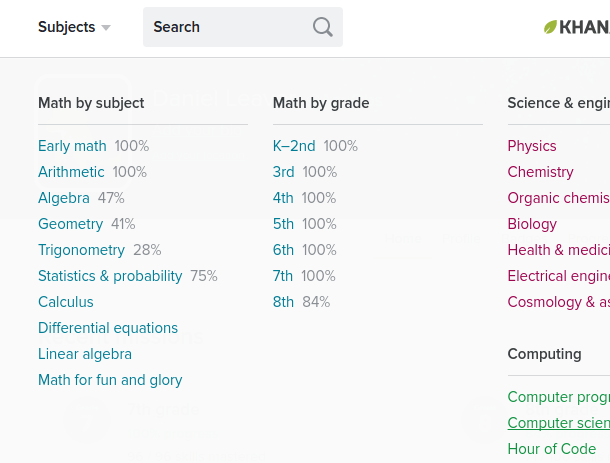
I have completed all K-2 through K-8 math, but need to master a bit more of the K-8 topics. You may noticed that I also have a bit of Algebra and Geometry under my belt. This is partly because when I first discovered the site, I started thought that it would be good to study By Subject. I didn’t realize that K-2 to K-8 meant because we have a completely different education system in France where we learn by grade throughout high school. But it turns out that in America they learn first by grade from K-2 to K-8, and in senior high school they learn their math by subject.
It was a real big surprise for me to go from Early Math to Arithmetic and Algebra, I thought the learning curve was quite steep there for a moment! But it is best to start by completing the math by grade, and then move onto completing the math by subject.
I think this is maybe a bit confusing for people like me who are not from the US. The math by age should the left hand side column and the math by subject should be the right hand side column. And perhaps there should be some sort of intuitive visual guide or notice when the website can detect that you are from countries other than the US.
Rate of Progression
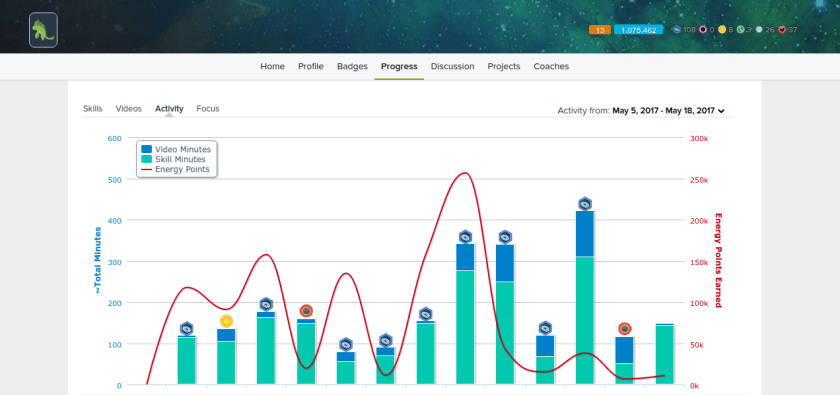
I read posts on quora about that tried to estimate the time it would take someone to complete the World of Math challenge on Khan Academy (100% math mastery) and the consensus was that it could take from 11 years to 15 hours depending on one’s skill level in Math and motivation.
How much time World of Math?
How long does it take to do World of Math?
Most the top posts on reddit.com/r/Khan also concern the World of Math challenge and try to estimate its time to completion.
So far the graph above will show that I have spent 39.2 hours on the World of Math mission. This doesn’t account for all the time I have spent on the challenge outside the website: asking for help on forums such as r/learnmath, and learning from articles and videos on youtube – which is probably another 5 hours.
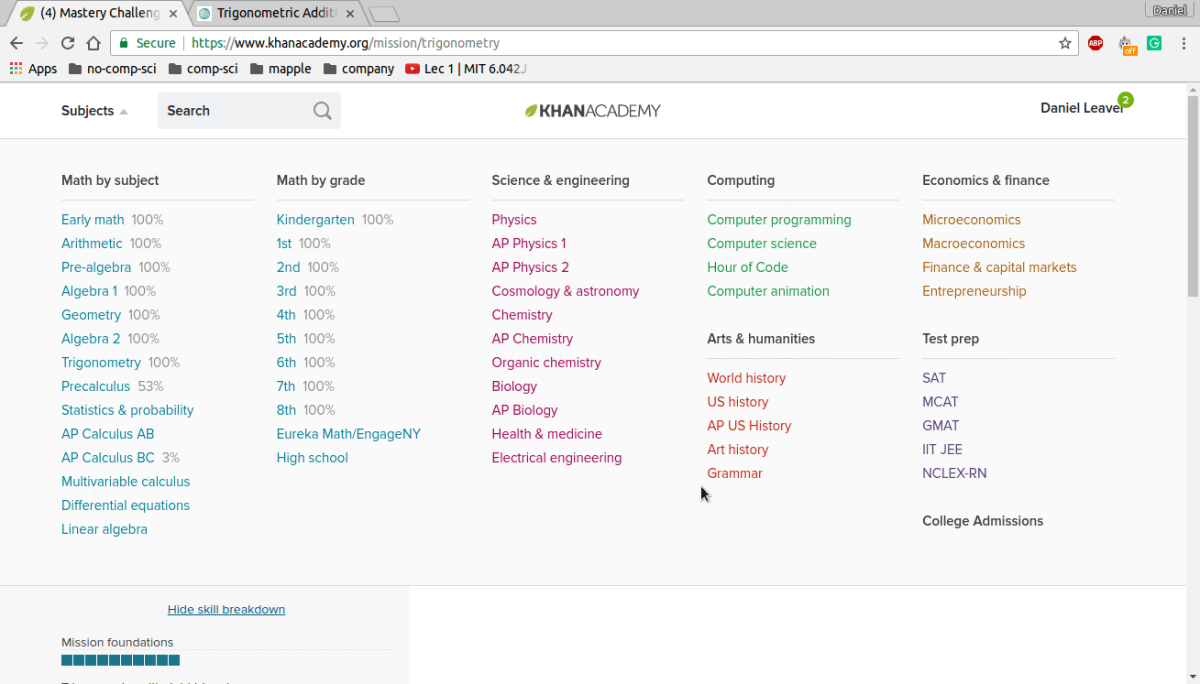
My current completion of the mission is 58%.
The progression is however not linear. It is very easy to progress through the mission at first. But you can see that the more I have been progressing, the more videos I have been watching and the slower by pace has been.
I am about to tackle more involved topics such as Algebra I & II, Calculus, Statistics and Probabilities, Trigonometry, and then advanced topics such as Linear Algebra and Differential Equations. I know a bit of each of those topics, but although K-2 K-8 was mostly revision, I think that it will take me much longer to go through the rest of these lessons because it will actually involved a lot of learning – and learning takes time.
I imagine that in 1 to 9 months from now I will have seen the light at the end of the tunnel and maybe even continued onto discrete math which is a University level math class considered very useful for computer scientists.
Icing on the cake
Got a mill’ points in the bank and 13 day streak, whoop whoop.
 Daniel Leaver