
Every year Stack Overflow does a Developer Survey where they ask their regular readers, those who might have a minute to spare in particular, to answer a few questions. In 2017 there were a total of 154 questions and over 60000 participants. It is one of the biggest community data-sets out there and luckily for us they published the results.
If you would like to query this data-set for yourself, it is possible. There is an easy to run MySQL project available at https://github.com/AzuObs/stack-overflow-survey.
In this article I’ll be going over some of the key insights gained form an afternoon of querying.
You might need to consider becoming an independent to work remotely.
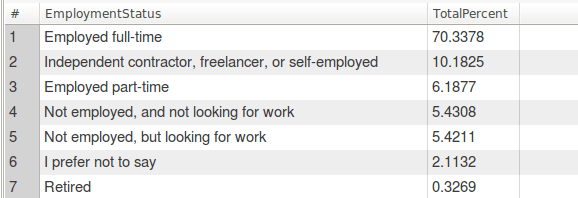
Fig A Employment Status for non-remotes
Fib A is the information we have about ALL developers who took part in the survey. The majority of people are full time employees, and there is a big step between those who are working as full time employees and those who have different situations such as being contractors.

Fig B Employment Status for remotes
Fig B contains the information about developers who have declared working remotely “All or almost all the time (I’m full time remote)”. By the way, this will be the way how I decide to categorise remote vs non-remote people throughout this article. We can see that a much higher percentage of people who work remotely do so by working independently rather than being in full time employment.

Fig C Employment Status for non-USA remotes
Fig C shows the trend is even more pronounced if we only consider non-USA based remotes. I assume that is probably because most overseas people who want to work for a US company do so as contractors so as to not require a visa. Whereas most of the US remotes are able to work as full time employees for most companies anywhere in the US. Personally, I’ve worked remotely before, and I indeed had to setup my own company because I was living in France and my employer (Maple Inside) were hiring me from Canada.
Working as an independent might have some downsides. Two that come to mind are that by working remotely you might therefor have less job security, and that independents will incur added responsibilities of running a formal business (company meetings, taxes, and all sorts of paperwork).
Personally, and having worked remotely previously, I would be very confident that these downsides would not outweigh to pros of decoupling my job market from my living place, having more independence, and enjoying more freedom.
Remote workers earn MORE on average their their non-remote counterpart
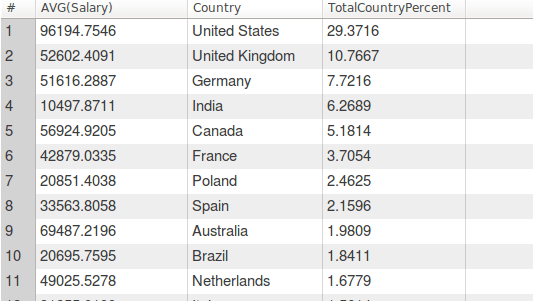
Average Earnings for non-remotes by country

Average Earnings for remotes by country
These results speak for themselves but could be seen as surprising. Remote workers are often working from rural places with a low cost of living and in globally competitive job market, yet they earn more. For US remote worker this could be because remote jobs attract more mature employees who have a lot of experience and might have chosen the remote lifestyle to offer a better quality of life to their families. For non-US remote workers this could perhaps be explained by those nationals who were able to work at higher rates for US based companies. US companies offering typically better compensation.
Remote workers don’t think remote collaboration is as hard as their office dwelling counterparts
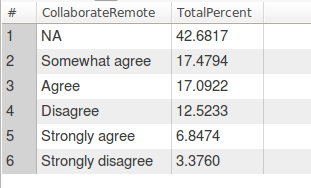
“Is remote collaboration hard?” answer by non-remotes
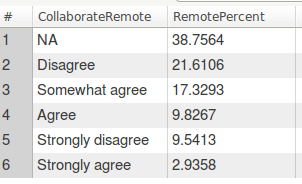
“Is remote collaboration hard?” answered by remote
Here remotes would much more often disagree with the statement “Remote collaboration is hard”.
Remote collaboration is undoubtedly one of the big challenges remote companies must consider when deciding to hire remote workers. But it would seem that some have found ways to make it work effectively. Nowadays excellent tools such as Slack, Google Hangouts, Google Docs, Trello, and cheap international flights make remote collaboration effortless.
Remote jobs are not only for US residents, although it might be easier for US residents
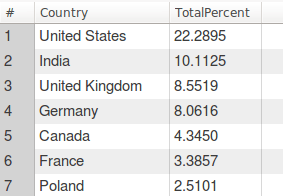
Work country of all workers
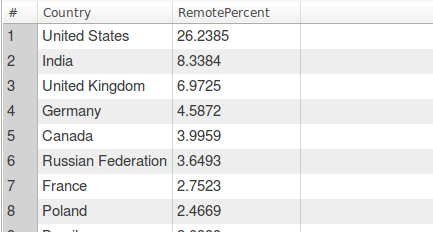
Work country of remote workers
Many remote roles are advertised as US-only. It should often be easier for US companies to hire US residents because the laws would be less awkward to work with than legal systems of entirely different countries. It turns out that out of all survey takers 22% were from the US, whereas 26% of the remote-only survey takers were from the US. So while an observation could be made that remote opportunities are probably more abundant for US citizens, it might not be that significant.
Other insights
The Stack Overflow data-set is full of wonderful eye opening insights and gives the opportunity to answer questions about the remote lifestyle numerically. I may have put forward the above, but there are more insights to be gained. Stack Overflow has made a survey summary of their own where you can find more information https://insights.stackoverflow.com/survey/2017.
 Daniel Leaver